

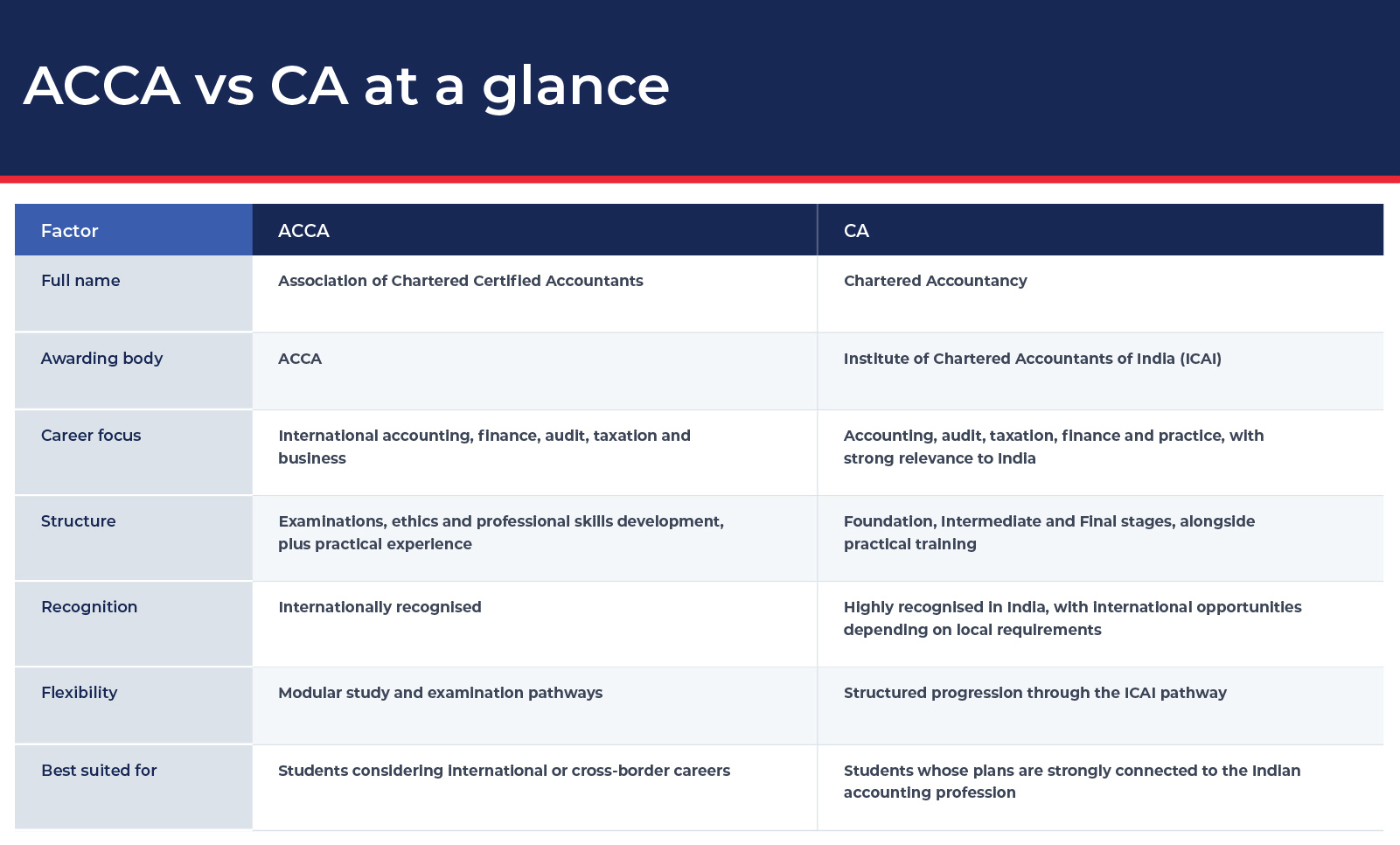
Neither qualification is universally better. CA may be more closely aligned with careers focused on India, particularly in areas such as Indian taxation, audit and regulation. ACCA may suit students seeking an internationally focused qualification and opportunities across different markets.
The ACCA vs CA for Indian students comparison is therefore less about finding a clear winner and more about finding the qualification that fits your intended career direction.
Take Your ACCA Next Step!
What is the difference between ACCA and CA?
Both qualifications cover areas such as accounting, finance, audit, taxation and business. The main difference is the professional environment each pathway is designed around.
CA in India follows the professional route established by the Institute of Chartered Accountants of India (ICAI). Its curriculum and training have strong relevance to Indian accounting, taxation, auditing and regulatory requirements.
ACCA, awarded by the Association of Chartered Certified Accountants, has a broader international focus. Its qualification is designed for professionals working across different markets, and ACCA has a global network of employers and accountancy partners.
That distinction matters if you are deciding between ACCA or CA with a particular destination or career path in mind.
ACCA vs CA: Eligibility for Indian students
Your eligibility depends on the qualification and the route available to you.
For ACCA, students who meet the required academic criteria may enter the ACCA Qualification directly. Students who do not meet the minimum requirements may have alternative entry routes through the Foundations level.
At GBS Dubai, the ACCA pathway includes entry routes based on qualifications equivalent to two A Levels and three GCSEs, including English and Mathematics. Alternative foundation routes may be available depending on academic background.
CA follows the entry routes established by ICAI. Students generally enter through the Foundation route, although graduates and certain other candidates may qualify for direct entry to later stages under applicable ICAI rules.
Because requirements can change, check the latest eligibility criteria with ACCA or ICAI before applying.
Course structure and syllabus
The two qualifications cover many similar areas, but the way students move through them is different.
ACCA course structure
The ACCA qualification covers subjects including:
- Financial accounting
- Management accounting
- Business and technology
- Corporate and business law
- Taxation
- Financial reporting
- Performance management
- Financial management
- Audit and assurance
- Strategic business leadership
- Strategic business reporting
At the Strategic Professional level, students complete the required essential papers and choose option papers based on their interests and career direction.
Passing the examinations is only part of becoming an ACCA member. Students also need to complete the relevant ethics and professional skills requirements and meet ACCA's practical experience requirements.
ACCA currently requires 36 months of relevant practical experience for membership, alongside its other requirements.
CA course structure
The Indian CA pathway includes:
- Foundation
- Intermediate
- Final
- Practical training
The syllabus covers subjects such as:
- Accounting
- Corporate and other laws
- Taxation
- Cost and management accounting
- Auditing and ethics
- Financial management
- Strategic management
- Financial reporting
- Advanced financial management
There is some overlap between ACCA and CA, but the context is different. CA has a strong connection with India's professional and regulatory environment, while ACCA has a broader international focus.
ACCA vs CA duration
There is no single completion time that applies to every student.
Your timeline can depend on:
- Entry point
- Academic background
- Exemptions
- Exam progression
- Study schedule
- Practical training or work experience
With ACCA, students can progress through the examination structure according to their circumstances, while relevant practical experience may be gained alongside their studies if it meets ACCA's requirements.
The CA pathway also involves multiple stages and practical training.
So instead of asking only, “Which course is shorter?”, consider which structure would work better with your academic background, preferred pace and career plans.
Is ACCA more difficult than CA?
This is one of the first questions students ask, but there is no objective answer.
Both are professional qualifications that require serious preparation. How difficult either feels can depend on your:
- Accounting and finance background
- Study habits
- Academic strengths
- Approach to examinations
- Time management
- Preferred learning style
CA is known for its demanding examination pathway and strong focus on the Indian professional environment. ACCA also involves challenging examinations, but its modular structure may appeal to students who prefer a more flexible route.
Rather than choosing based on which qualification is supposedly easier, compare the subjects, structure and career relevance.
Global recognition: ACCA vs CA
For Indian students considering an international career, recognition is an important part of the decision.
ACCA has a global professional network and works with more than 7,300 Approved Employers and over 80 global accountancy partners. However, holding an ACCA qualification does not automatically provide the right to undertake every regulated accounting activity in every country. Local legislation, licensing and employer requirements may apply.
That means ACCA may support opportunities in international markets, but you should always check the requirements for the particular country and role you are targeting.
CA is particularly well established in India and may be especially relevant for careers involving Indian taxation, auditing, accounting and corporate regulations.
Which is better for your career location?
| Career goal | Qualification that may be more relevant |
| Build a career primarily in India | CA may offer stronger alignment with the Indian professional and regulatory environment |
| Explore opportunities in the UAE | ACCA may be relevant for internationally focused accounting and finance roles, subject to employer and local requirements |
| Pursue opportunities across several international markets | ACCA may offer a more internationally oriented pathway |
| Focus on Indian taxation, audit and regulation | CA may be a stronger fit |
| Prefer a modular and internationally focused study structure | ACCA may be more suitable |
Neither qualification guarantees employment. Your experience, skills, professional network, employer expectations and the requirements of your chosen market can all influence your career prospects.
Career opportunities after ACCA and CA

Both qualifications can lead to a range of accounting and finance roles. The opportunities available to you would depend on your experience, location, employer and any additional requirements attached to the role.
Potential career paths after ACCA
Depending on experience and local requirements, ACCA students and professionals may pursue roles such as:
- Financial accountant
- Management accountant
- Internal auditor
- External audit professional
- Financial analyst
- Tax consultant
- Finance manager
- Risk and compliance professional
- Business analyst
- Corporate finance professional
If you are considering an international accounting career, the qualification is only one part of the picture. Relevant work experience, technical skills and an understanding of the market you want to enter can also matter.
For a closer look at the potential value of the qualification, you can explore how an ACCA certificate course may support an accounting and finance career.
Potential career paths after CA
CA professionals may pursue opportunities in:
- Chartered accountancy practice
- Audit and assurance
- Taxation
- Financial reporting
- Corporate finance
- Financial management
- Consulting
- Internal audit
- Investment and advisory roles
The direction you take after qualifying can depend on the experience you build, the sector you enter and any additional skills or qualifications you develop.
CA vs ACCA salary: What Influences Earning Potential
A CA vs ACCA salary comparison can be misleading if it treats the qualification as the main factor determining earnings.
Salary can vary considerably based on:
- Country and city
- Years of experience
- Employer
- Industry
- Job role
- Professional membership status
- Additional qualifications and skills
A newly qualified accountant and an experienced finance manager are likely to have very different salary expectations, regardless of whether they hold ACCA or CA.
For that reason, it may be more useful to research the salary range for the role and location you are targeting.
An Indian student planning to work in India might compare finance roles in Indian companies and professional services firms. Someone considering Dubai may instead look at compensation for accounting and finance roles in the UAE.
ACCA vs CA costs
The total cost of either qualification can vary.
For ACCA, expenses may include registration, annual subscription, examination fees, study materials and tuition from an education provider. The number of examinations taken and any exemptions can also affect the total.
For students considering an ACCA course in Dubai, it is important to separate the costs of studying with an education provider from the fees payable directly to ACCA.
The CA pathway also involves registration, examination, training and other applicable costs.
Fees and regulations can change, so use current information from ACCA, ICAI and your chosen education provider when working out your budget.
Flexibility: ACCA vs CA
Flexibility can be particularly important if you want to combine professional study with work or other commitments.
The ACCA qualification has a modular examination structure, and relevant practical experience can be gained through appropriate accounting or finance roles while you progress, provided the experience meets ACCA's requirements.
CA follows a more structured professional route with defined stages and practical training.
If being able to balance professional study with relevant work experience matters to you, the ACCA structure may be worth considering.
Why consider an ACCA course in Dubai?
For Indian students looking beyond India, Dubai may offer an interesting setting in which to pursue an internationally oriented accounting qualification.
The city has a large international business community and a diverse student population, which can provide exposure to people and organisations from different markets.
GBS Dubai is located in Dubai Knowledge Park and offers an ACCA programme covering the qualification's progression from foundational routes through to professional-level subjects, depending on a student's entry route and eligibility.
GBS Dubai is also an ACCA Gold Approved Learning Partner, according to its published programme information.
Students considering the qualification can find more information about the ACCA course at GBS Dubai or consider the reasons to pursue an ACCA course from Dubai.
ACCA or CA: Which is better for Indian students?
The answer comes down to where you want your career to go.
CA may suit you if:
- You primarily want to build your career in India.
- You are particularly interested in Indian taxation, auditing and regulatory practice.
- You want to follow the Indian chartered accountancy pathway.
- You see yourself working within India's corporate or professional services environment.
ACCA may suit you if:
- You are interested in an internationally recognised accounting qualification.
- You want to consider opportunities across different markets.
- You are considering building your career in the UAE or another international location.
- You prefer a modular qualification structure.
- You want exposure to internationally focused accounting, finance and business subjects.
There is no need to treat the ACCA vs CA for Indian students decision as a competition between two qualifications. The more useful question is which one matches the career you have in mind.
Choosing the right accounting qualification for your future

Both CA and ACCA can provide a strong foundation in accounting and finance, but the routes are different.
CA may be the natural choice for someone whose professional plans are closely tied to India, particularly in taxation, audit and regulatory work. ACCA may appeal more to someone who wants an internationally focused qualification and is considering markets such as the UAE or other countries.
If your plans extend beyond India, think about the locations, industries and roles you may want to pursue. Then look at which qualification fits those plans, rather than choosing based on reputation alone.
The right qualification is the one that makes sense for where you are starting, where you want to work and the kind of accounting career you want to build.
Frequently asked questions about ACCA vs CA which is better
1. Which is better for Indian students: ACCA or CA?
2. What is the difference between ACCA and CA?
ACCA is an internationally oriented professional accountancy qualification, while CA in India follows the professional pathway established by ICAI and has strong alignment with the Indian accounting, taxation, auditing and regulatory environment.
3. Is ACCA recognised in India?
ACCA is an internationally recognised professional accountancy qualification and is known to employers in India. However, recognition for specific regulated activities, professional rights or statutory roles can depend on Indian regulations and employer requirements. Students should check the requirements for the particular role they plan to pursue.
4. Is ACCA more difficult than CA?
Both are challenging professional qualifications. The difficulty may depend on your academic background, strengths, preparation and preferred learning structure. Comparing the content, assessment format and career relevance may be more useful than deciding based on which qualification is perceived as harder.
5. Which qualification offers better salary prospects: ACCA or CA?
Salary prospects vary according to country, role, experience, industry, employer and professional status. Neither qualification guarantees a specific salary. Students should compare compensation for the particular roles and locations they are considering.
6. Can ACCA professionals work in the UAE and other countries?
ACCA may support career opportunities in the UAE and other international markets, depending on employer requirements and local regulations. Some roles or regulated activities may require additional licences, registrations or qualifications.
7. How long does it take to complete ACCA compared with CA?
The duration depends on factors such as entry route, exemptions, exam progression and practical experience. ACCA membership currently requires completion of its examinations and ethics requirements, along with at least 36 months of relevant practical experience.
8. What are the eligibility requirements for ACCA and CA?
Eligibility depends on the qualification and entry route. ACCA has minimum academic requirements for direct entry, with Foundations-level options for students who do not meet them. CA eligibility depends on the applicable ICAI entry route. Always check the latest requirements before applying.
9. Is ACCA worth pursuing for an international career?
For students planning an international career in accounting or finance, ACCA may be worth considering because of its global professional network and international qualification framework. The decision should also take into account the country, role and professional requirements you are targeting.
10. Why should Indian students choose ACCA over CA?
Indian students may consider ACCA if their career plans are internationally focused, if they are interested in markets such as the UAE, or if they prefer ACCA's qualification structure and subject focus. CA may be a better fit for students whose long-term plans are primarily centred on the Indian accounting profession. The decision should come down to career direction rather than the assumption that one qualification is automatically better.