

Dubai can be a strong option for Indian students looking for an international education experience closer to home. According to KHDA, Dubai's private higher education sector enrolled 42,026 students in 2024-25, while international students made up around 35% of the total student population.
Why consider higher education in Dubai as an Indian student?

Dubai is often considered by Indian students for a combination of practical and academic reasons. Its proximity to India can make travel home more convenient, while its multicultural environment offers the experience of living and studying alongside people from different parts of the world.
The city's higher education landscape is also diverse. KHDA reported that 37 of Dubai's 41 private higher education institutions were international branch campuses in the 2024-25 academic year.
For Indian students, the decision may come down to a few important factors:
- Studying in an international environment closer to home
- Accessing different qualification pathways
- Choosing from career-focused areas of study
- Experiencing life in a major regional business hub
- Building an international network while studying
If you are comparing Dubai with other study abroad options, our guide to studying in Dubai as an Indian student offers a closer look at what students should consider before making the move.
Start Your Dubai Journey!
What are the admission requirements for Indian students?
Admission requirements vary according to the institution and programme. A student applying for a diploma may not need to meet the same requirements as someone applying for an HND or another higher-level qualification.
However, Indian students will generally need to provide evidence of their academic background and identity.
Documents commonly requested
Depending on the programme, you may need:
- Class 10 and Class 12 certificates and mark sheets
- Previous academic transcripts
- University certificates or transcripts, where relevant
- A valid passport
- Passport-sized photographs
- Proof of English language proficiency, where required
- Any additional documents requested for the specific programme
Before submitting your application
It is worth checking:
- The academic qualification required for entry
- Whether there are subject-specific requirements
- Whether English language evidence is needed
- Which documents need to be submitted
- Whether the qualification offers a progression route that matches your plans
Checking these details early can save time later and help you apply for a programme that genuinely fits your academic profile.
How much does it cost to study in Dubai for Indian students?
The cost of studying in Dubai for Indian students depends on several factors. Tuition fees are one part of the calculation, but accommodation, food, transport, visa-related costs, health insurance and personal expenses also need to be considered.
What should your budget include?
| Expense | Estimated cost | What to plan for |
|---|---|---|
| Tuition fees | Varies by programme and institution | Check the total programme fee and whether instalment plans or scholarships are available. |
| Accommodation | From around AED 2,300 to AED 8,000+ per month | Costs vary significantly depending on whether you choose shared accommodation, a private room or a studio. Current GBS Dubai accommodation rates from September 2026 range from AED 2,300 for some shared options to AED 8,000 for a premium studio. |
| Food | Around AED 800 to AED 1,500+ per month | Your spending will depend on how often you cook, eat out and your personal preferences. |
| Transportation | Around AED 70 to AED 175 per month with a student travel pass | Eligible students can receive a 50% concession on Dubai public transport. Current 30-day student nol passes range from AED 70 for one zone to AED 175 for all zones. (RTA) |
| Visa and documentation | Approximately AED 7,000 to AED 10,000+ initially, depending on the institution and application circumstances | This may include visa processing, medical examination, Emirates ID and other administrative charges. Fees vary between institutions and student circumstances. (UOW Dubai) |
| Health insurance | May be included in the visa package or charged separately | Check exactly what is covered by your institution's visa and insurance arrangement before budgeting separately. |
| Study materials | Around AED 500 to AED 2,000 per year | This may include books, software, printing and other course-related requirements. A laptop or other device could add to the initial cost. |
| Personal expenses | Around AED 500 to AED 1,500+ per month | Mobile plans, leisure, clothing and other day-to-day spending will depend largely on your lifestyle. |
The most useful approach is to look at the complete cost of your study plan, rather than comparing destinations or institutions on tuition fees alone.
Your budget will also depend on the lifestyle you choose. Sharing accommodation, cooking more frequently and using public transport, for example, can affect your monthly spending.
Understanding the Dubai student visa process
After receiving admission to an eligible institution, Indian students will need to complete the relevant steps for their UAE student residence visa.
According to the UAE Government, eligible students may be sponsored by an accredited university or college, or in some circumstances by an eligible parent who is a UAE resident. Educational institutions can facilitate the visa process for their students.
Documents and requirements
Requirements can vary, but students may need to provide:
- A valid passport
- Admission or enrolment documentation
- A certificate from the educational institution confirming the duration of study
- Passport photographs
- Other documents requested as part of the application process
As visa rules and requirements can change, students should always confirm the latest information before applying.
For a closer understanding of the steps involved, you can look through Dubai student visa process.
What is student life in Dubai like for Indian students?
The academic side of studying abroad is only one part of the experience. Once you arrive, everyday life begins with practical questions: Where will you live? How will you travel? What will your monthly routine look like? How will you meet people and settle into a new environment?
Dubai's multicultural population can make that transition less unfamiliar for international students. Your experience, however, will depend greatly on where you live, how you manage your budget and the kind of routine you create for yourself.
What student life may involve
- Finding accommodation that suits your budget and preferences
- Using the Metro, buses and other transport options
- Managing groceries and day-to-day expenses
- Meeting students from different countries
- Taking part in campus activities
- Exploring the city during your time outside classes
Students may choose shared accommodation to manage costs and build a social circle, while others may prefer a more independent living arrangement. Your commute can also shape your daily experience, so accommodation is worth considering before you finalise your plans.
To get a better sense of the support, experiences and opportunities that can shape your time outside the classroom, take a look at student life at GBS Dubai.
Can Indian students work while studying in Dubai?
Students may have access to training and employment opportunities in the UAE, subject to the relevant regulations and permit requirements.
The UAE Ministry of Human Resources and Emiratisation provides a student training and employment permit for eligible establishments to train or employ students under specific conditions.
Before accepting a job or internship, students should check:
- Their eligibility
- The permit requirements
- The conditions attached to the work arrangement
- Whether the opportunity can be balanced with their studies
Part-time work can provide useful experience and supplementary income. However, students should avoid relying on expected earnings as the primary way to fund their education and living costs.
What career opportunities can follow higher education in Dubai?
A good study decision should involve thinking about what happens after the classroom as well.
Dubai's economy includes sectors such as business, financial services, technology, construction, logistics and healthcare. KHDA reported that business, information technology and engineering were among the largest fields of study within Dubai's private higher education sector in 2024-25, with growth also seen in areas including information technology, engineering, health and medicine.
Study areas and potential career directions
| Area of study | Potential career direction |
|---|---|
| Business | Operations, management and entrepreneurship |
| Digital technologies | Technology, AI and cybersecurity-related roles |
| Construction | Construction and project-related roles |
| Accounting and finance | Accounting, finance and professional pathways |
| Health and social care | Management and support roles within relevant sectors |
No course can guarantee a job. Career outcomes will depend on your qualification, skills, experience and the opportunities you pursue.
For that reason, it is useful to ask one question before choosing a programme:
What skills will this qualification help me build, and where could those skills take me?
Why choose GBS Dubai for higher education?
Once you have narrowed down your preferred subject and qualification level, the next question is where you want to study.
GBS Dubai offers career-focused programmes across areas including business, digital technologies, artificial intelligence, cybersecurity, construction, health and social care, and accounting and finance pathways.
The choice of institution should not be based on a course title alone. Indian students should also consider:
- The qualification and awarding body
- Entry requirements
- Programme content
- Progression opportunities
- Tuition fees and payment arrangements
- Student support
- How the programme connects with their longer-term goals
For students who want to compare their options, the full range of courses at GBS Dubai can help them identify a qualification pathway that fits their academic background and career plans.
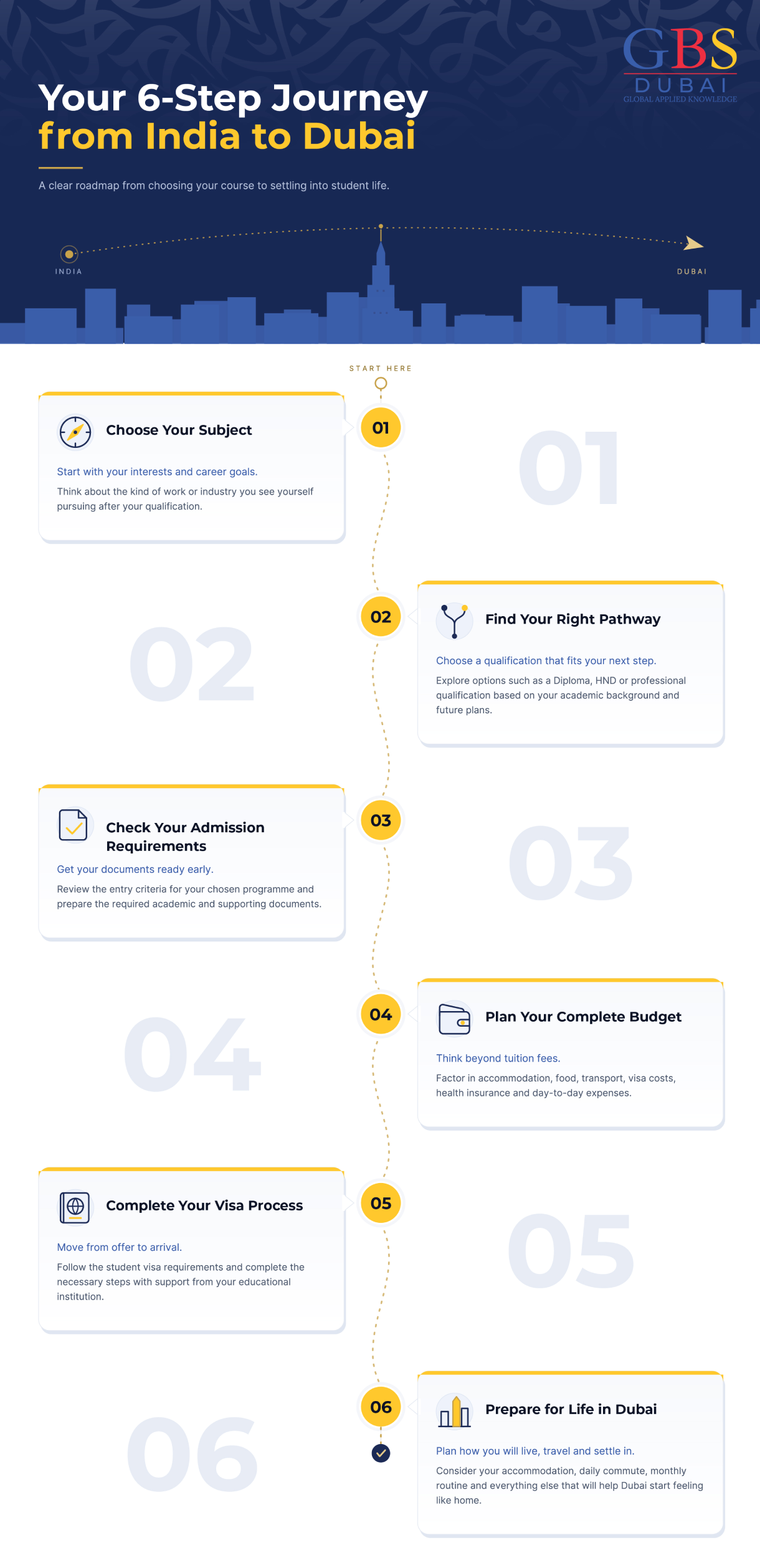
Building your higher education journey in Dubai

For Indian students, Dubai offers several routes into higher education rather than a single fixed path. You might begin with a diploma, move into an HND, pursue further study or work towards a professional qualification, depending on your goals.
The key is to make the decision with a clear understanding of what comes next.
Dubai's private higher education sector continues to grow, and Indian students form the largest share of its international student population. KHDA's 2024-25 data shows that Indian students accounted for 42% of international students studying in Dubai's private higher education institutions.
That does not mean Dubai will automatically be the right choice for every student. The right destination and qualification will depend on your budget, academic background and career plans.
Before applying, take the time to compare your options properly. Check the entry requirements, calculate the complete cost of studying, understand the visa process and consider what skills and opportunities the qualification could support.
If those pieces come together, higher education in Dubai can become a well-planned step towards your next academic or professional goal.
Frequently asked questions about higher education in Dubai for Indian students
Q1: Is Dubai a good place for Indian students to pursue higher education?
Q2: What are the admission requirements for Indian students in Dubai?
Requirements vary by institution and programme. Students may need academic certificates and transcripts, a valid passport, photographs and proof of English language proficiency where required. Always check the entry requirements for your chosen programme.
Q3: How much does it cost to study in Dubai for Indian students?
The overall cost depends on the institution, qualification and lifestyle. Students should budget for tuition fees, accommodation, food, transport, health insurance, visa-related costs, study materials and personal expenses.
Q4: Can Indian students work part-time while studying in Dubai?
Students may be able to access employment or training opportunities, subject to UAE regulations and the relevant conditions. The UAE Government outlines rules for the training and employment of students, including requirements relating to student status, residence visas and, in some cases, approval from the educational institution.
Q5: What documents are required for a Dubai student visa?
Requirements can vary, but the UAE Government states that students applying for a student visa must provide a certificate issued by their university or institute specifying the duration of study, alongside meeting other applicable requirements.
Q6: Are qualifications earned in Dubai internationally recognised?
Recognition depends on the institution, awarding body and specific qualification. Before applying, students should check who awards the qualification, its recognition status and the progression or career opportunities it can support.
Q7: Are there scholarships available for Indian students in Dubai?
Scholarships, fee reductions or other forms of financial support may be available depending on the institution and eligibility criteria. Students should check directly with their chosen provider for current opportunities and conditions.
Q8: What are the best courses to study in Dubai for Indian students?
The right course depends on your interests and career plans. According to KHDA's 2024-25 data, business, information technology and engineering were among the leading areas of study in Dubai's private higher education sector, while information technology, engineering, and health and medicine recorded strong enrolment growth.
Q9: Can Indian students stay and work in Dubai after graduation?
This depends on an individual's employment opportunities and the applicable UAE residence and work requirements at the time. Students planning to remain in the UAE after graduation should check the latest immigration and employment regulations before making long-term plans.
Q10: Why should Indian students choose GBS Dubai for higher education?
GBS Dubai offers career-focused qualification pathways across areas such as business, digital technologies, construction, health and social care, and accounting and finance. Students can consider different pathways based on their academic background and future goals, while studying in an international environment in Dubai.