
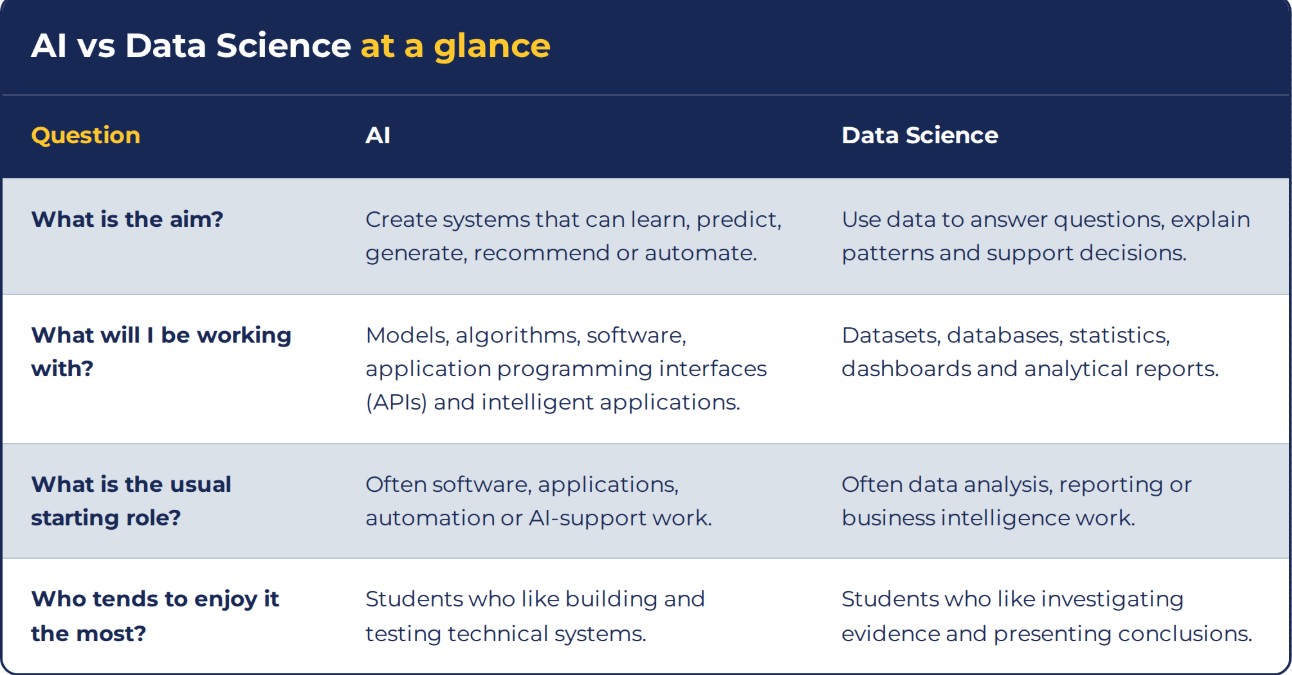
Data Science uses data to find patterns, answer questions and support decisions. AI focuses on building systems that can learn, predict, generate, recommend or automate. The fields overlap because AI systems need data and data scientists often use machine learning.
Want to Study AI in Dubai?
Key differences between AI and Data Science
• The questions each field asks
Data science asks, “What can we learn from this data?” A retailer may examine sales data to understand why customers stop buying. A hospital may analyse appointment data to reduce waiting times. The result could be a forecast, a dashboard or a recommendation.
AI asks, “Can a system perform this task or improve with experience?” Examples include recognising an object in an image, detecting an unusual payment or suggesting the next product a customer may need. Machine learning sits inside AI and is also used in data science, which is where the two fields meet.
• The balance of mathematics and coding
Both routes use mathematics and programming, but the balance can differ. Data Science normally gives more attention to statistics, data quality and interpretation. AI commonly places more weight on algorithms, model behaviour and software development. Course titles are not enough to judge that balance; the module list will tell you more.
• The work produced
A data science assignment may end with an analysis that a manager can use. An AI assignment may end with a working prototype and a test of how well it performs. Good courses in either field should also teach you to explain limitations, handle data responsibly and document your choices.
Course subjects
• What subjects are taught in an AI course
AI course subjects vary, but students commonly study programming, AI and intelligent systems, machine learning, big data, cloud computing, software development, cyber security, application development, testing and responsible AI. A research-oriented degree may include more calculus, linear algebra and advanced model theory. An applied diploma may spend more time building and testing solutions.
The current GBS Dubai HND in Digital Technologies (Artificial Intelligence Solutions and Applications) is an applied programme. Its published modules include:
- Programming
- Big Data and Visualisation
- Cloud Fundamentals
- Software Development Lifecycles
- Cyber Security
- Fundamentals of Artificial Intelligence and Intelligent Systems
- Business Intelligence
- Internet of Things
- Emerging Technologies
- Risk Analysis and Systems Testing
- Application Development
- Application Program Interfaces
- Digital Sustainability
• What subjects are taught in a Data Science course
A Data Science course will usually cover:
- Statistics and probability
- Python or R programming
- SQL and databases
- Data cleaning and exploratory analysis
- Data visualisation
- Machine learning
- Business intelligence, cloud analytics or data engineering in some programmes
Look at depth as well as breadth. A course can list machine learning but devote only one short unit to it. Check the hours, assessment briefs and final project. For an Indian student comparing institutions in different countries, it is also worth checking the qualification level and the route into further study.
Skills required to study AI or Data Science

You do not need to arrive as a programmer. However, you do need to be willing to practice. These foundations make the first year easier:
- School-level mathematics: Algebra, functions, probability and statistics appear on both routes. Some AI degrees go further into calculus and linear algebra.
- Basic coding: Python is a sensible place to start. Learn how variables, loops and functions work, then try a small project.
- Care with detail: Real data is messy and the code fails. Identifying the reason is part of the work, not a reflection of your suitability.
- Clear communication: You may need to explain what you did, why you did it and how confident you are in the result.
- Judgement: Privacy, bias and security are practical concerns. Technical accuracy alone is not enough.
• Is AI harder than Data Science
Not automatically. AI may feel more challenging if you have little interest in software development or abstract mathematics. Data Science can be just as demanding when a project involves poor-quality data, statistical uncertainty and a business question with no tidy answer. The harder course is usually the one that does not suit your working style.
Career opportunities
• Career opportunities after an AI course
Early AI career opportunities are not limited to the job title 'AI engineer'. Depending on the qualification and your project work, you might begin in application development, software testing, automation, technical support or a junior AI or machine-learning role. With stronger programming, mathematics and experience, routes can open towards machine-learning engineering, AI solutions, computer vision, natural language processing or responsible AI work.
Be realistic about specialist titles. AI researcher role often requires postgraduate study, and machine-learning engineering jobs typically require solid software engineering. A portfolio with two well-explained projects is more useful than a long list of tools you have only tried once.
• Career opportunities after a Data Science course
Data Science career opportunities often begin with data analyst, reporting analyst, business intelligence analyst or data-quality roles. A junior data scientist position is possible, although employers may expect stronger statistics and project experience. Later moves can include data engineering, product analytics, experimentation, machine learning or analytics management.
Data roles extend well beyond technology companies. Banks, retailers, consultancies, manufacturers, healthcare organisations and the public services all use data. Your knowledge of the sector can become an advantage as your career develops.
• Career designations and indicative salaries in India
The figures below are national average base-salary snapshots from different samples and experience levels. They are not starting salary promises.
| Pathway | Role or designation | Indicative average |
| AI | Artificial Intelligence engineer | About ₹6.00 lakh a year |
| AI | Machine-learning engineer | About ₹11.43 lakh a year |
| Data Science | Data analyst | About ₹6.35 lakh a year |
| Data Science | Data scientist | About ₹12.44 lakh a year |
| Data Science | Business intelligence developer | About ₹7.28 lakh a year |
• Which has better career opportunities AI or Data Science
Data Science offers a broad set of entry points because many organisations need analysts before a dedicated AI team. AI offers specialised growth for students who build strong coding and model-development skills. The boundary is also moving: data professionals use machine learning, while AI teams require people who understand data quality and analysis.
Employer forecasts show demand for both skill sets, although they cannot decide which course is right for you. The World Economic Forum’s Future of Jobs Report 2025 places AI and big data among the fastest-growing skills to 2030. It also lists big data specialists and AI and machine-learning specialists among the fastest-growing roles by percentage. These forecasts signal employer demand, but they do not guarantee employment for individual graduates.
Salary and career growth in India
Salary websites can be useful, but only when you compare like with like. A data analyst is not the same role as a data scientist, and an AI engineer is rarely an entry-level benchmark for every Artificial Intelligence graduate.
The career table provides role-level salary context. The figures cover different samples and experience levels, so they should not be used to rank one course above the other.
Career growth depends on what you can do after the course. In Data Science, SQL, statistics, visualisation and the ability to explain a business result can move you beyond reporting work. In AI, stronger software engineering, model evaluation and deployment skills can lead towards more specialised roles. In both fields, internships, projects and steady learning matter.
Which course is better for Indian students
Do not choose based on which label sounds newer. Pick AI if you enjoy making things work: writing code, testing a model, finding faults and improving a system. Pick Data Science if you enjoy asking why, checking evidence and turning a large amount of information into a clear answer.
Your current subjects do not have to decide your whole career, but they are a useful indicator. A strong interest in Mathematics and Computer Science can support either option. Commerce students may find business analytics a natural route into Data Science. Students from other streams can enter too, provided they meet the course requirements and are ready to build their quantitative and coding skills.
Location matters as well. If you are considering study outside India, compare the qualification, teaching style, total cost, entry requirements and progression route. Do not assume that the same course name carries the same content everywhere.
Should I choose AI or Data Science after Class 12
Try this process before applying:
- Read the modules: Mark the subjects you genuinely want to study. Ignore the course name for a moment.
- Test both fields: Use one public dataset to answer a question, then build a small prediction or classification project. Take note of which task holds your attention.
- Check the entry rules: Ask the institution to assess your Class 12 qualification and English evidence. Requirements vary by course and country.
- Look at assessment: Projects, case studies and portfolios show how you will learn. A course based mainly on theory may suit a different student than one built around practical assignments.
- Compare progression: Find out what further study the qualification can lead to and which roles normally require a degree or postgraduate work.
- Speak to people: Ask a lecturer, current student or practitioner what their week actually involves. Specific answers are more helpful than broad claims about “the future”.
A practical AI option at GBS Dubai
Students who decide to study AI can explore the Pearson-awarded HND in Digital Technologies (Artificial Intelligence Solutions and Applications) at GBS Dubai. The course is currently listed as a two-year programme in Dubai, with weekday, weekend and evening delivery. Assessment includes assignments, case studies, presentations, reports and portfolio evidence rather than formal examinations.
The course is an AI pathway, not a standalone Data Science programme. Compare its published modules with the Data Science courses on your shortlist, then ask the admissions team to confirm the academic and English requirements for your Indian qualification.
The short answer to your AI vs Data Science debate

AI suits students who want to build intelligent systems. Data Science suits students who want to investigate data and guide decisions. There is useful overlap, so choosing one does not close the door on the other. The best course is the one whose actual modules and projects match the work you want to learn.
Salary data should remain context rather than the deciding factor. In the September 2026 snapshots used for this guide, average base salaries ranged from about ₹6.35 lakh a year for data analysts to ₹12.44 lakh for data scientists, while machine-learning engineers averaged about ₹11.43 lakh. These mixed-experience averages are not starting salaries or guaranteed outcomes.
Frequently asked questions
Q1. What is the difference between AI and Data Science?
Q2. Which is better, AI or Data Science for Indian students?
Neither is better for every Indian student. AI is usually a stronger fit if you enjoy programming and building technical systems; Data Science may suit you better if you enjoy statistics, analysis and explaining evidence. Compare the actual modules and projects before deciding.
Q3. Is AI harder than Data Science?
Not necessarily. AI can demand more software development and algorithm work, while Data Science can be challenging because of statistics, data cleaning and uncertain results. Your interests and current foundations will affect which one feels harder.
Q4. What subjects are taught in an AI course?
Common AI course subjects include programming, intelligent systems, machine learning, big data, cloud computing, application development, software testing, cyber security and responsible AI. The balance differs between theoretical degrees and applied diplomas.
Q5. What subjects are taught on a Data Science course?
A Data Science course commonly covers statistics, probability, Python or R, SQL, databases, data cleaning, data visualisation and machine learning. Some programmes also include business intelligence, data engineering or cloud analytics.
Q6. What skills are required to study AI?
Useful starting skills include school-level mathematics, logical thinking and a willingness to practise coding. Clear communication, attention to detail and responsible judgement also matter. You do not need to be an expert programmer before joining the course unless the entry requirements say otherwise.
Q7. What career opportunities are available after completing an AI course?
Depending on your qualification and portfolio, you may explore application development, automation, software testing, technical support or junior AI and machine-learning work. Specialist positions such as machine-learning engineer or AI researcher often require deeper experience or further study.
Q8. What career opportunities are available after a Data Science course?
Common starting points include data analyst, reporting analyst, business intelligence analyst and data-quality roles. With further experience, you may move towards data science, product analytics, data engineering, machine learning or analytics management.
Q9. Which has better career opportunities: AI or Data Science?
Data Science currently provides a broad range of analytical entry routes across industries. AI offers more specialised pathways for students with strong programming and model-development skills. Employers increasingly need a mixture of both, so projects and practical ability matter more than the course title alone.
Q10. Should I choose AI or Data Science after Class 12?
Choose AI if you want to build intelligent applications and are prepared for regular coding. Choose Data Science if you would rather analyse information and use it to guide decisions. Check entry requirements, assessments, progression options and costs before committing to either route.